Violin lessons Launceston & Sydney
Masterclasses & Online Lessons



| TEACHING THE MIND My book and lessons are purposefully intended to address the common problem of practice without progress. This historical "forever problem" can be addressed by teaching the mind the technique of a sequential timeline. What looks like instinct is actually sequenced cognition internalised:
THE ENIGMA Despite the availability of global teaching resources, masterclasses, and methods, co-ordination and intonation continue to be the most significant technical problems in the examination room. The renowned viola pedagogue Lillian Fuchs is reputed to have remarked, in relation to co-ordination, words to the effect of: “Jump up, scream, and then play.” Whether apocryphal or lightly paraphrased, the vividness of this anecdote reflects the persistent gaps in advanced technical guidance offered by traditional pedagogy | 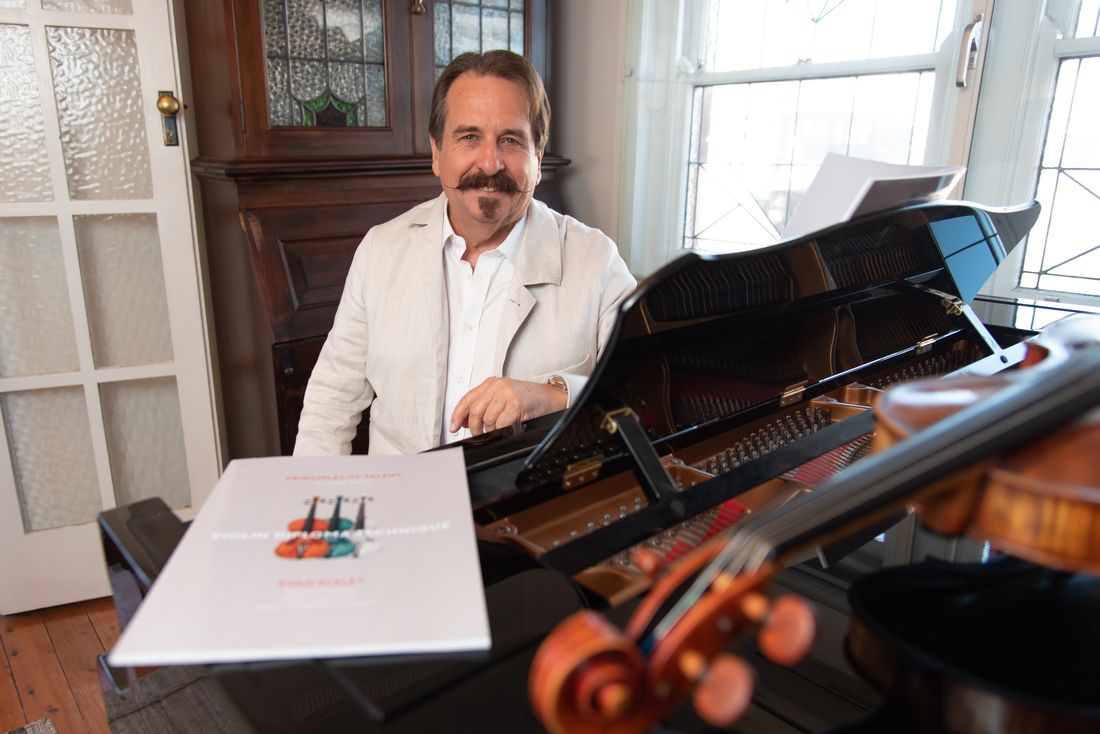 |
TRY THESE SAMPLES OF TALENT:
Technical talent is multifaceted, it also includes, for instance, the sensation of physical ease. With the following examples, experience how understanding the positive and negative sensations of gravity gives greater ease and security to the player. Explore the following examples to feel this directly.
- Using whole bows, play an up bow on the E string and let it fall naturally to the G string.
- Then compare this sensation by playing a down bow on the E string followed by an up bow on the G string.
- Do position changing in the upper half of the bow.
- Then compare this sensation with doing the position changes at the heel.
When changing strings, it is physically easier to use gravity. When shifting, it is physically easier to shift in the upper half of the bow. Knowing what is physically easy allows students to be in technical control of their musical decisions.
LESSONS AND MASTERCLASSES
In my book, lessons, and masterclasses, the intuitive techniques of causal logic are clearly defined and demonstrated. These include the missing techniques of the "enigma", such as: "Connecting, active listening, how to hear single note vibrations as double stops, pivot points, soundscape volume, first and second pressure points, stopping angle, moment of co-ordination, natural forces, sensations." Each of these is a specific micro-moment in the timeline sequence.
HISTORY OF TECHNICAL TALENT
Once the temporal foundation is secure, different historical periods require different additional abilities. Historically, violin technique is not a linear process of "step by step" progress. Each musical period introduces totally different technical expectations. Great performers composed their own compositions that showcased their individual technical talents. Technique developed for financial reasons, the need to attract an audience.
- In all periods, intonation and co-ordination security are essential techniques. These require the ability of active listening.
- In late Classicism, the violin bow transitioned to the modern design. This required players to develop new abilities of awareness of the forces of nature. Bowing techniques, especially when string crossing are influenced by air pressure, balance points, and gravity.
- In early Romanticism, fast passagework required the new abilities of directional momentum and virtuosic speed. This comes from applying many of the same techniques that are used in sport and dance. These include techniques such as muscle groups, preparation concepts, postural security, and physical invention.
- In late Romanticism and Twentieth Century, the techniques of logistical analysis and individual invention are required. When the mind uses the technique of a timeline, it has a foundation upon which it can then add the other abilities of talent.
| MUSICAL IDEAS Once timeline and historical layers are mastered, technical facility becomes the platform upon which musical ideas are executed. Musical ideas, score detail, stylistic characteristics, tone quality concepts occur during the time of the bow's follow through. Different types of bow strokes occur at the moment of co-ordination. Overall, candidates are well taught musically, it is their technical facility that falters. This book focusses on these technical problems. It builds on tradition. NERVOUSNESS When the mind is fully occupied with a thinking technique, it has no time to think about being nervous. MENTAL CONFUSION FROM TRADITIONAL PEDAGOGY
In sum, technical talent rests on a foundation of temporally ordered cognition. Historical developments, natural forces, and stylistic demands all build upon this foundation. When students learn to sequence, sense, and apply techniques logically, technical mastery becomes consistent, musical decisions become secure, and performance anxiety naturally diminishes. |
小提琴才能研究
- 你被告知要听,但不知道如何做?
- 你被告知要按调弦演奏,但不知道如何做?
- 你被告知要协调,但不知道如何做?
- 你从一个老师那里转到另一个老师那里吗?
- 你练习却没有进步吗?
尽管勤奋练习,并接受了大师教师的指导,成功并不总是确保的。传统的教学方法,对一些人有效,但往往无法为大多数人带来广泛的成功。从历史上看,在满足大多数候选人的学习需求方面,教授文凭级别技术的“如何做”通常过于模糊。时间轴定义了技术才能的详细科学。没有奇迹,只有魔法。
La recherche sur le talent de jeu en violon
- Êtes-vous invité à écouter, mais ne comprenez pas comment?
- Êtes-vous invité à jouer juste, mais ne comprenez pas comment?
- Êtes-vous invité à coordonner, mais ne comprenez pas comment?
- Passez-vous d'un professeur à un autre?
- Pratiquez-vous sans progresser?
Malgré une pratique assidue et des instructions de maîtres enseignants, le succès n'est pas toujours garanti. Les méthodes pédagogiques traditionnelles, efficaces pour certains, échouent souvent à se traduire par un succès généralisé pour beaucoup. Historiquement, l'enseignement du "comment faire" des techniques de niveau diplôme a été trop vague dans les détails, ne répondant pas aux besoins d'apprentissage de la plupart des candidats.
Une chronologie définit la science détaillée du talent technique. Il n'y a plus des miracles, juste de la magie.
Studia talentu gry na skrzypcach
- Czy ci mówią, żebyś słuchał, ale nie wiesz, jak?
- Czy ci mówią, żebyś grał czysto, ale nie wiesz, jak?
- Czy ci mówią, żebyś koordynował, ale nie wiesz, jak?
- Czy chodzisz od jednego nauczyciela do drugiego?
- Czy ćwiczysz bez postępów?
Mimo pilnej praktyki i instrukcji od mistrzów nauczycieli, sukces nie jest zawsze gwarantowany. Tradycyjne metody pedagogiczne, skuteczne dla niektórych, często nie przekładają się na powszechny sukces. Historycznie, nauczanie "jak robić" techniki na poziomie dyplomowym są zbyt mgliste w szczegółach, nie spełniając potrzeb nauki dla większości kandydatów.
Wykres lini czasu uczy jak osiągnąć talent techniczny. Nie potrzebujesz już cudów, znasz magie.